The right nightstand height has nothing to do with the nightstand and everything to do with your bed. Measure the mattress, then match it: here’s the chart, plus how wide a nightstand can be when the space beside the bed is tight.
5 min read
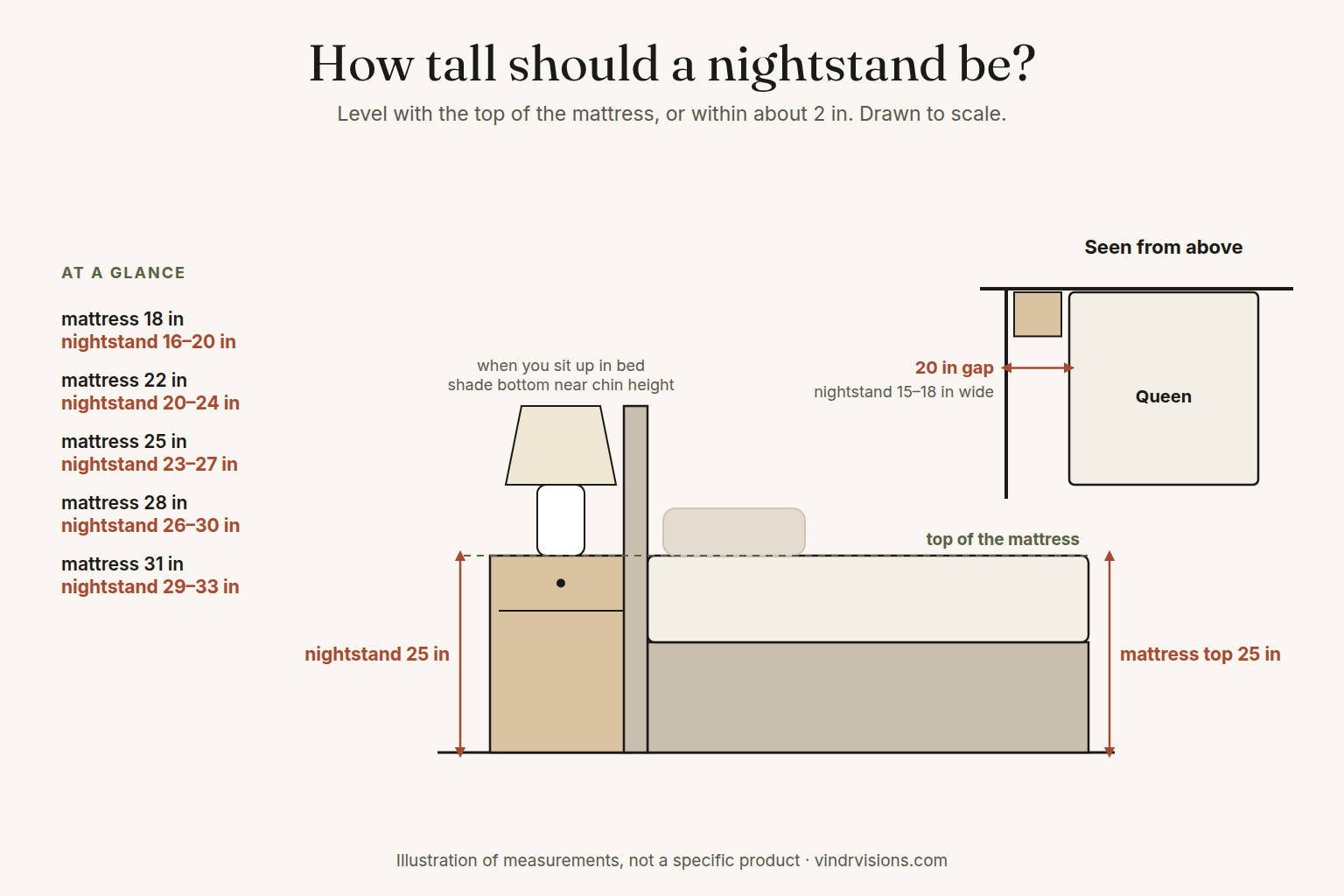
Keep the top of the nightstand level with the top of your mattress, or within about 2 in of it. Measure from the floor to the top of the mattress, including any topper; most beds land at 24–28 in, which is why most nightstands are that tall. Then pick a width at least 2 in narrower than the gap beside the bed.
Jump to a section
The rule: level with the mattress
When the nightstand top is level with the mattress, you can put down a glass or pick up your phone without stretching up or reaching down in the dark. It also looks balanced: the line of the mattress continues across the nightstand. A couple of inches either way is fine; much more than that and the nightstand starts to look either like a stool or like a wall beside the bed.
The chart by mattress height
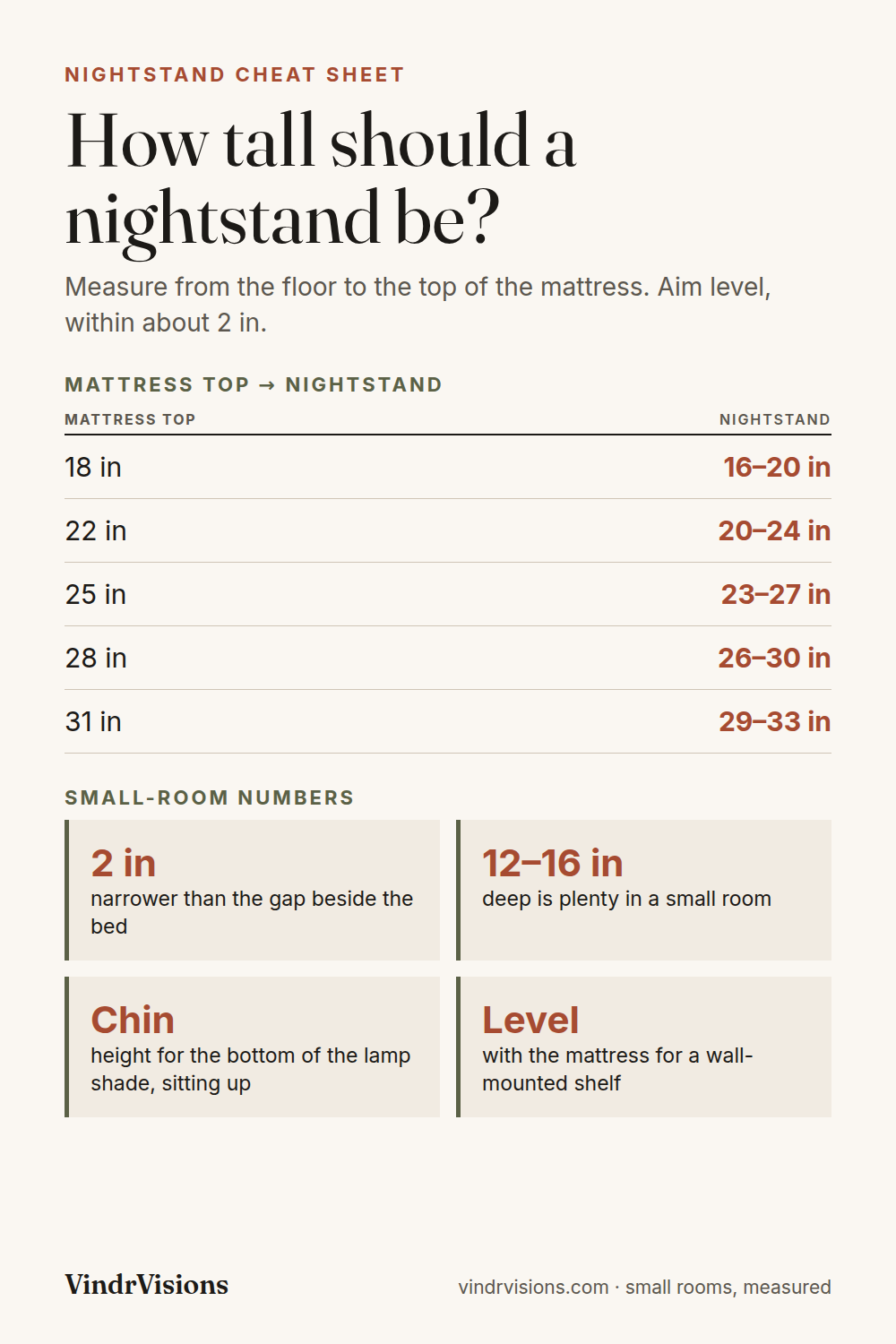
| Mattress top from the floor | Nightstand height | Typical bed |
|---|---|---|
| 18 in | 16–20 in | low platform or floor bed |
| 22 in | 20–24 in | low frame or slim mattress |
| 25 in | 23–27 in | standard frame and mattress |
| 28 in | 26–30 in | thick mattress or a box spring |
| 31 in | 29–33 in | tall frame with a box spring |
Standard nightstands are usually 24–28 in tall, so a low platform bed often needs a lower one than the stores display first. Search by height, not just by style.
Measure your bed
- Make the bed the way you normally sleep in it, with any mattress topper on.
- Measure from the floor to the top of the mattress at the side, near the pillows.
- Measure the gap between the side of the bed and the wall, or the next piece of furniture.
- Note whether a door, window or radiator sits in that gap.
Planning a new bed? Add the frame height to the mattress thickness: a 14 in frame and an 11 in mattress put the top at about 25 in.
Width and depth in a small room
Choose a nightstand at least 2 in narrower than the gap beside the bed, so it doesn’t rub the wall or the bedding. In a 20 in gap, that means 15–18 in wide. Slim nightstands around 9–12 in wide fit even tighter gaps; they hold a lamp or a phone and a book, not much more.
Depth matters as much as width in a small room: 12–16 in is plenty. A deep nightstand sticks out past the pillows and narrows the path beside the bed. If the gap is also your way to the window or the closet, keep that route at least 24 in wide.
Wall-mounted and under-mattress options
A floating nightstand mounts on the wall, so you can set its top exactly level with the mattress and keep the floor clear underneath. Fix it as the instructions say, into studs or with suitable anchors, and check your lease first.
No gap at all? A bedside shelf that slides under the mattress holds a tray at mattress level without using any floor. It suits a bed pushed into a corner or a loft bed.
The lamp on top
With a table lamp, aim for the bottom of the shade to sit around chin height when you sit up in bed. Then the bulb stays out of your eyes and the light falls on the page. If the nightstand is low, choose a taller lamp; if it’s tall, a shorter one. For a tight bedside, compare the options in Wall Lamp or Table Lamp? A Small-Bedroom Guide.
Already own one that doesn’t match?
If your nightstand is a few inches too low, a taller lamp and a tray on top make it easier to use. If it’s much lower than the bed, a wall-mounted shelf at mattress height above it adds a surface within reach. If it’s taller than the mattress by more than a couple of inches, it will keep feeling awkward; that’s the one worth replacing.
Common questions
Should a nightstand be higher or lower than the bed?
Neither, ideally: level with the top of the mattress. Within about 2 in higher or lower still works well.
How tall is a standard nightstand?
Most are 24–28 in, which matches a standard bed frame with a typical mattress.
What height nightstand for a low platform bed?
Measure the mattress top: with a low platform it is often 16–22 in, so look for a nightstand of about the same height, or mount a floating one at that height.
How wide should a nightstand be in a small bedroom?
At least 2 in narrower than the gap beside the bed. In a 20 in gap, 15–18 in wide; in tighter spaces, a 9–12 in slim nightstand or a wall shelf.
Can I use a shelf as a nightstand?
Yes. A wall-mounted shelf or floating nightstand at mattress height works well in a small room, as long as it’s fixed securely and your lease allows it.
Save this measurement checklist
- Floor to top of mattress: ___ → nightstand height (±2 in): ___
- Gap beside the bed: ___ → nightstand width (at least 2 in less): ___
- Nightstand depth (12–16 in in a small room): ___
- Path beside the bed stays 24 in or wider: yes / no
- Lamp: shade bottom near chin height when sitting up: ___
Sources and limits
These are widely used furniture-sizing rules of thumb. Beds and mattresses vary, so measure your own bed with its bedding on, check each product’s listed dimensions, and follow the installation instructions and weight limits for anything mounted on the wall.