Hang the rod higher and wider than the window, then buy the panel length that matches the rod, not the window. Here are the numbers for the four most common ceiling heights, plus the two measurements that decide everything.
6 min read
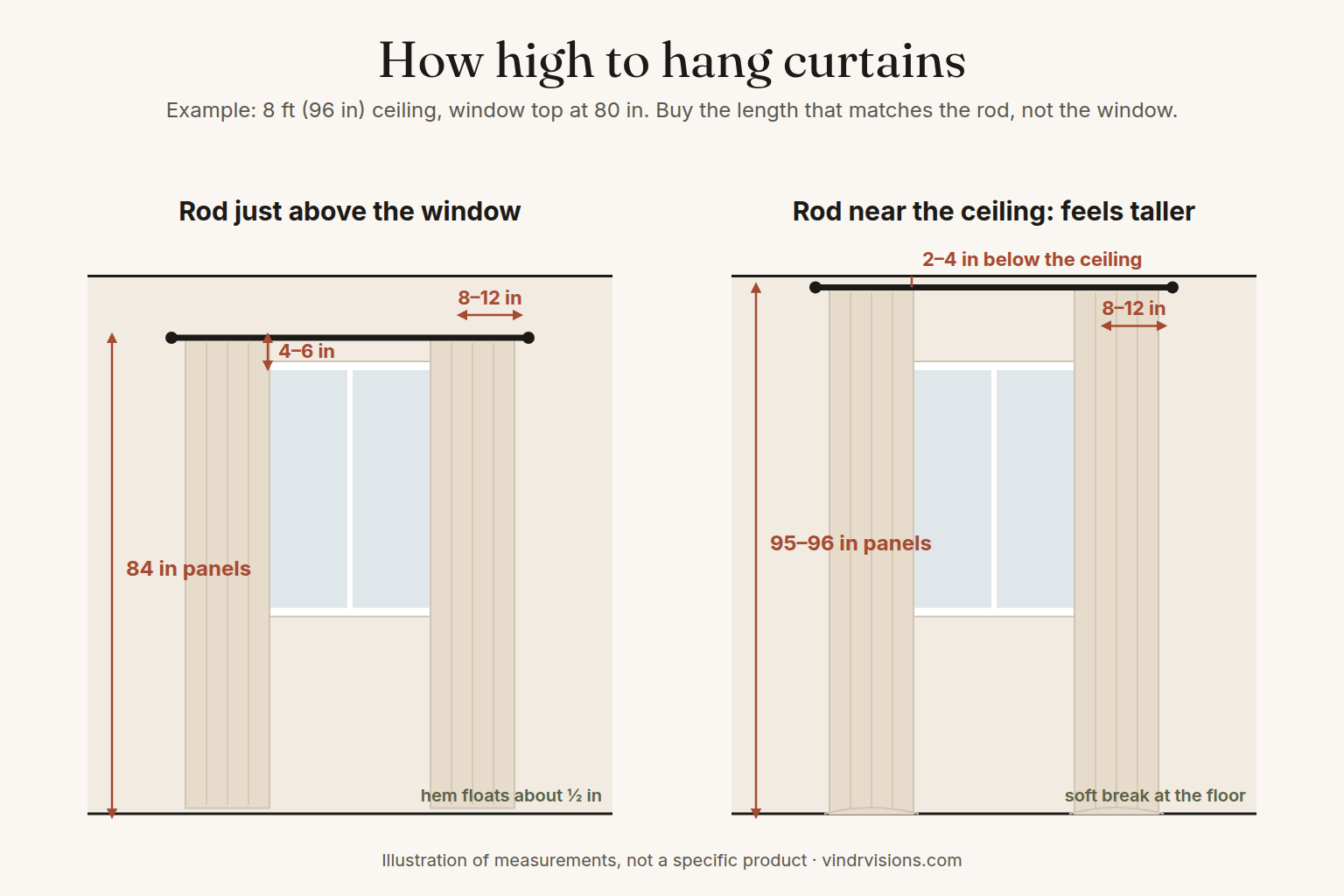
Mount the rod 4–6 in above the window frame, or 2–4 in below the ceiling if you want the room to feel taller. Let it run 8–12 in past the frame on each side. Then measure from the top of the rod to the floor and buy the standard length that matches: 84, 95–96, 108, 120 or 144 in.
Jump to a section
The chart: rod height and panel length
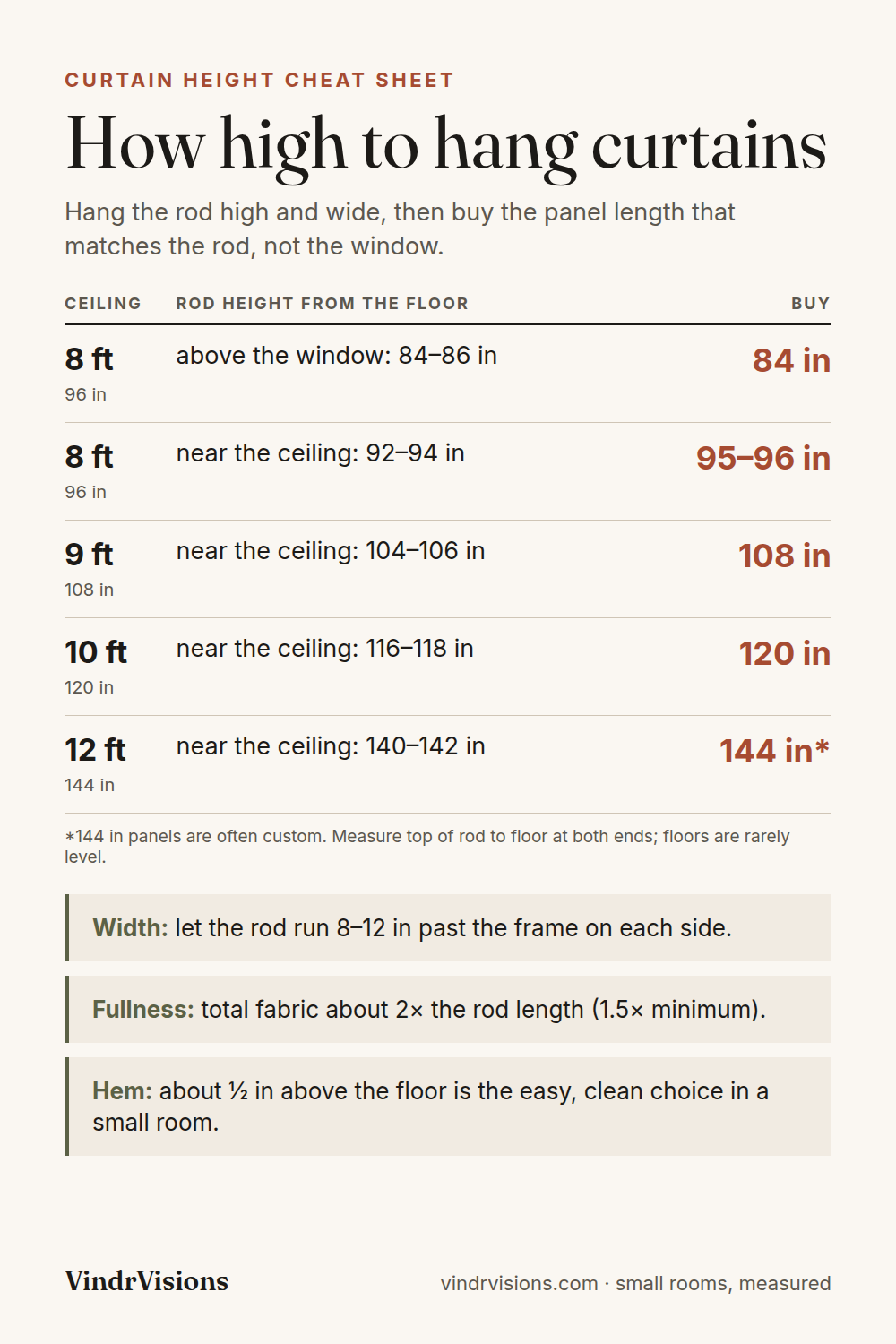
Every row follows one rule: the panel length you buy is roughly the distance from the top of the rod to the floor. Find your ceiling height, choose a rod position, and read across.
| Ceiling | Rod height | Buy | The hem |
|---|---|---|---|
| 8 ft (96 in) | 84–86 in, just above a standard 80 in window | 84 in | floats about ½–2 in |
| 8 ft (96 in) | 92–94 in, near the ceiling | 95 or 96 in | soft break of 1–4 in |
| 9 ft (108 in) | about 95–97 in | 96 in | floats about ½ in |
| 9 ft (108 in) | 104–106 in, near the ceiling | 108 in | soft break of 2–4 in |
| 10 ft (120 in) | about 107–109 in | 108 in | floats about ½ in |
| 10 ft (120 in) | 116–118 in, near the ceiling | 120 in | soft break of 2–4 in |
| 12 ft (144 in) | about 119–121 in | 120 in | floats about ½ in |
| 12 ft (144 in) | 140–142 in, near the ceiling | 144 in, often custom | soft break of 2–4 in |
Ready-made curtains come in steps of roughly 12 in, so a rod tucked near the ceiling usually leaves a little extra fabric on the floor. That soft break looks relaxed and intentional. If you want a crisp hem instead, lower the rod an inch or two, or hem the panels with iron-on hem tape.
The way a panel hangs also shifts the hem. Grommet panels ride about an inch higher than the rod, because the fabric continues above the grommets. Panels on clip rings hang 1–2 in lower. When you’re on the edge between two sizes, check the measuring diagram on the listing before ordering.
Choose the rod height
There are two good positions. Just above the frame, 4–6 in up, is the classic choice and works with 84 in panels on a standard 8 ft ceiling. Near the ceiling, 2–4 in below it or below any crown molding, the fabric draws one long vertical line from top to bottom, and the eye reads the wall as taller.
In a small room the higher position is the bigger visual win, especially with panels close to the wall color. Leave enough space above the brackets for the hardware and finials, and avoid mounting the rod directly on the frame: it makes the window look short and puts a hard horizontal line exactly where you don’t want one.
Make the rod wider than the window
Let the rod run 8–12 in past the frame on each side. Open panels then stack beside the glass instead of over it, so you keep the daylight, and the window looks wider than it is. Rod length is the outside width of the frame plus 16–24 in: a 40 in window needs a rod of about 56–64 in.
For fullness, aim for total fabric width about twice the rod length, and no less than 1.5 times. On a 60 in rod, two 54 in panels give 108 in of fabric, about 1.8 times the rod: full enough to look generous when closed, light enough to stack neatly when open. Sheers look best a little fuller.
Pick a hem that suits a small room
- Float: about ½ in above the floor. Tailored, easy to vacuum around, and the safest choice with pets, radiators or a busy walkway.
- Kiss: the hem just touches the floor. Clean, but it needs an exact measurement and a level floor.
- Break: 1–3 in of extra fabric resting on the floor. Softer and forgiving if your floor isn’t level.
- Puddle: 6 in or more. Formal, but it collects dust and takes floor space, so skip it in a small room or next to a door.
Measure in five minutes
- Decide the rod height and mark both ends of the rod on the wall with low-tack tape.
- Measure from the top of each mark to the floor. Floors and ceilings are rarely level, so use the shorter number.
- Subtract ½ in for a floating hem, or add 1–3 in for a break.
- Choose the standard length closest to that number. Between two sizes, move the rod rather than living with curtains that are too short.
- Measure the outside width of the frame and add 16–24 in for the rod.
If you can’t drill
A tension rod inside the frame is the simplest renter option, but it can’t go higher or wider than the window, so it gives up the taller look. Tap-in brackets that grip the window trim and brackets that clip onto a blind headrail can hold a rod outside the frame without screws in the wall. We compare these setups in Hide the Vertical Blinds: Curtain Setups for a Rental Window. Whatever you choose, follow the hardware’s weight limits and check your lease.
Common questions
Should curtains touch the floor?
They don’t have to. About ½ in above the floor looks tailored and is the easiest to live with. Touching the floor or a 1–3 in break looks softer. What matters most is that the hem doesn’t stop well above the floor, which makes the window look short.
Are 84 inch curtains too short?
On an 8 ft ceiling with the rod 4–6 in above a standard 80 in window, 84 in is usually right. If you move the rod up near the ceiling, you need 95 or 96 in panels.
How far above the window should a curtain rod be?
Start at 4–6 in above the frame. For a taller look, go as high as 2–4 in below the ceiling and buy longer panels to match.
How wide should a curtain rod be?
About 8–12 in past the frame on each side, so the rod is the frame width plus 16–24 in. That lets open curtains clear the glass.
What if my curtains are too short?
Lower the rod until the hem floats about ½ in above the floor, or hang the panels from clip rings to gain an inch or two. If neither is enough, add a fabric band at the bottom or buy the next standard length.
Save this measurement checklist
- Rod height from the floor: ___
- Top of rod to floor, left / right (use the shorter): ___ / ___
- Hem: float (−½ in), kiss (0) or break (+1–3 in): ___
- Panel length to buy: ___
- Frame width + 16–24 in = rod length: ___
- Fabric width, about 2 × rod length: ___
Sources and limits
These are widely used decorating rules of thumb, not building or safety standards. Window heights and floors vary, so measure your own room, follow each product’s installation instructions and weight limits, and check your lease before drilling.