Choose a wider single frame, a deliberate pair or a layered ledge—and give your favorite artwork a clearer relationship to the sofa.
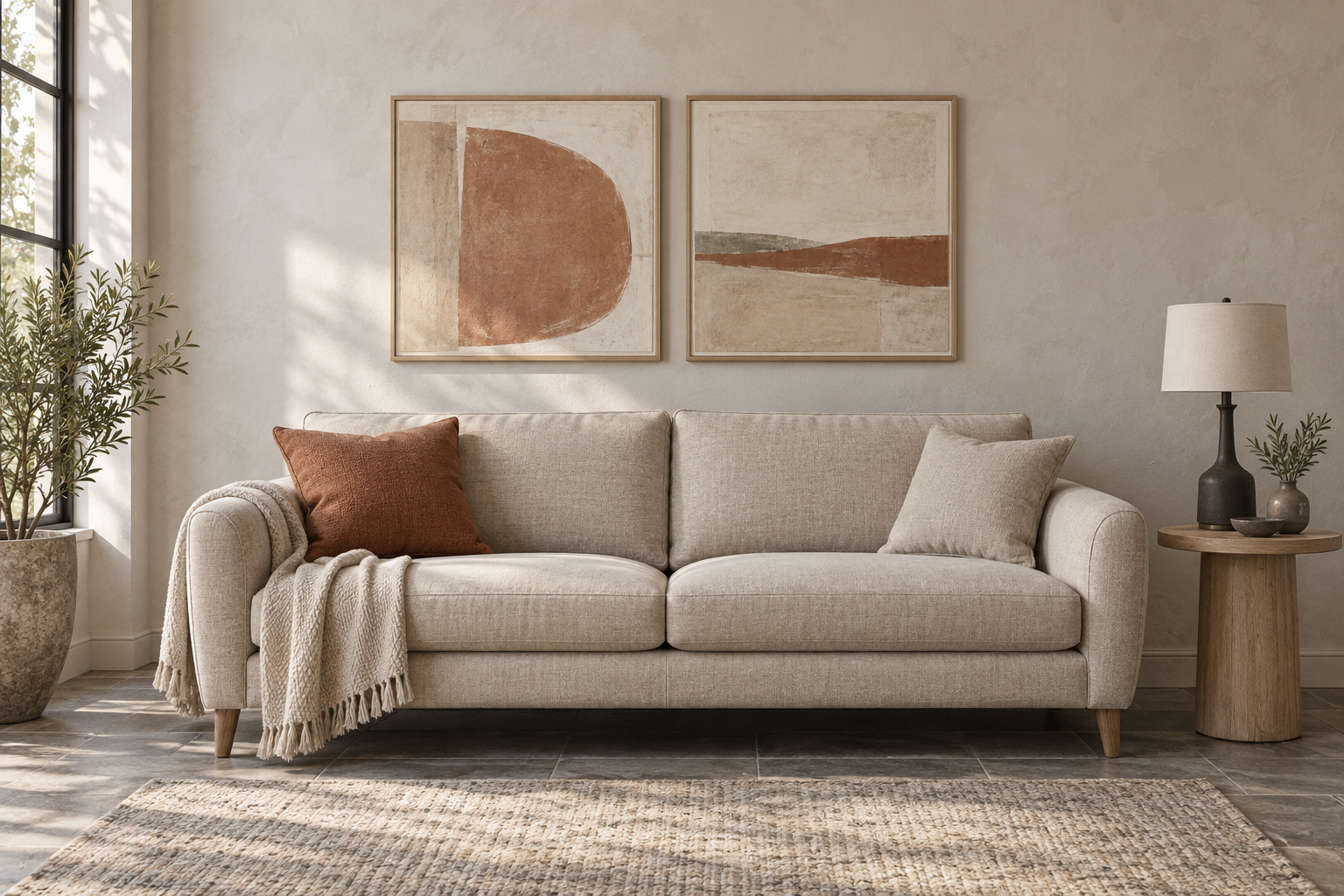 Concept image
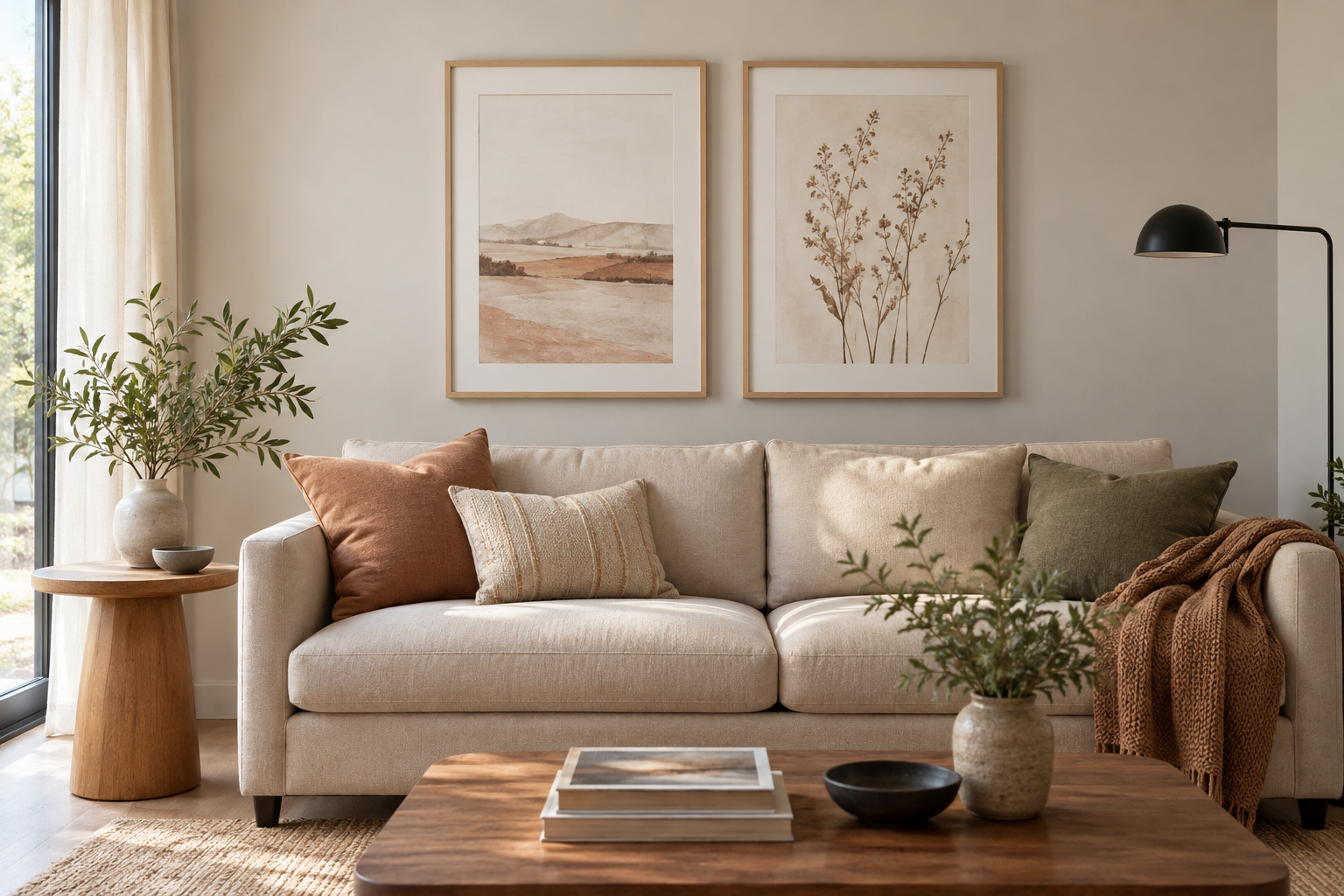
Try treating two smaller prints as one composition: matching frames, aligned edges and a consistent gap can give them a shared outline above the sofa. Choose one horizontal frame for a quieter focal point, or a picture ledge if you regularly rotate artwork.
Start with the whole composition
A favorite print can seem stranded when its outline occupies only a small patch above a broad sofa. Use roughly two thirds of the sofa’s width as a starting guideline for the composition. Measure a pair or group across its outer edges, including the spaces between frames.
Start with the composition centered over the sofa and its lowest edge about 6–10 inches above the back. These are starting guidelines, not requirements: judge the relationship from across the room. Before hanging frames, choose wall fixings appropriate to their weight and your wall.
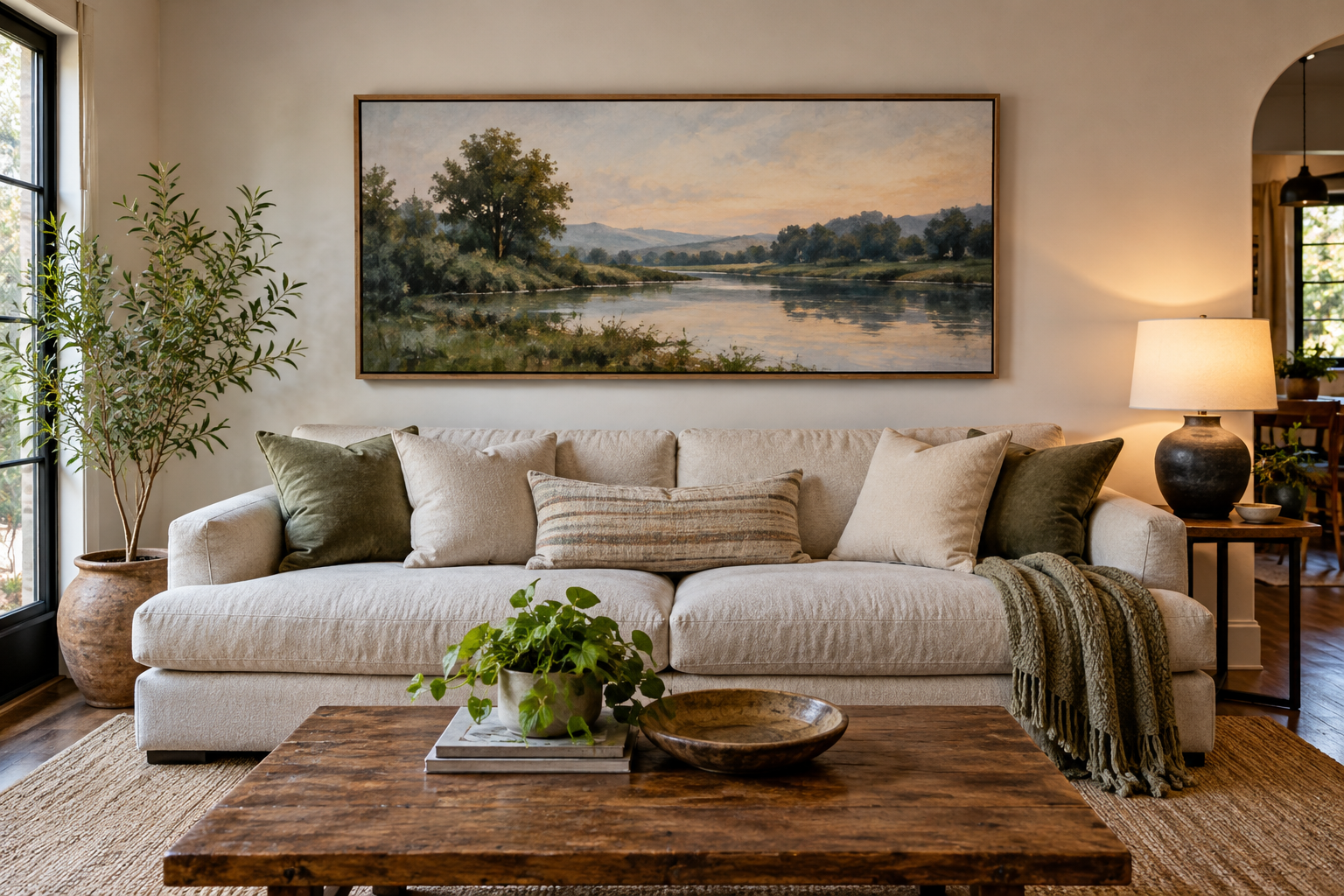
One horizontal image or two connected prints
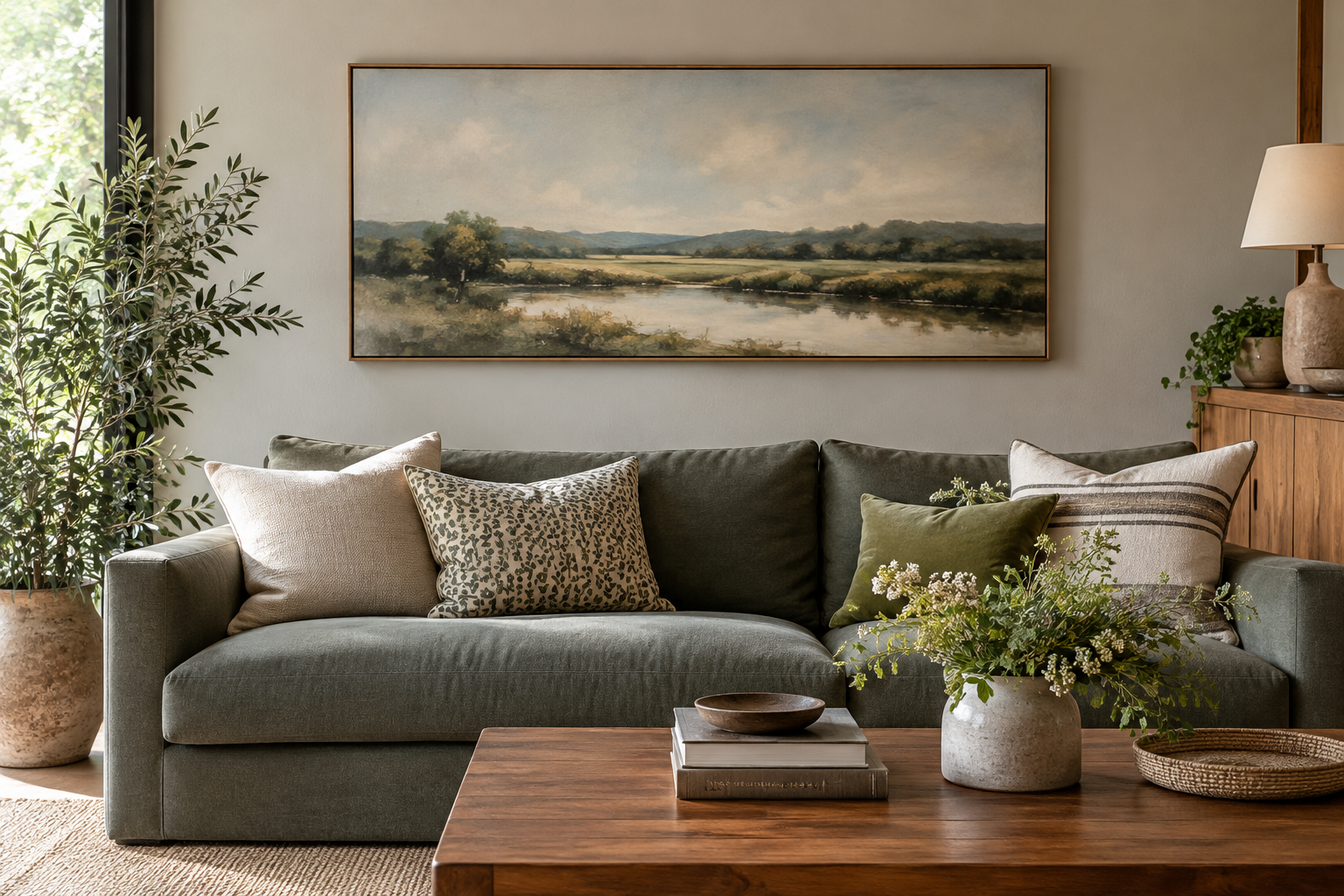
Choose one horizontal frame if you want a quiet focal point. A broad landscape or abstract with generous open areas offers one uninterrupted image to look at. It is the calmer choice above a sofa that already carries patterned cushions, where another busy arrangement may feel unnecessary.
Choose a pair to keep smaller works in the arrangement. Matching frame profiles and aligned top edges can give two different images a shared structure. Include the gap in the total span, keeping the prints close enough to feel related. The listed frames suit 24 × 36-inch artwork for either arrangement; compare the complete outline with your sofa before choosing.
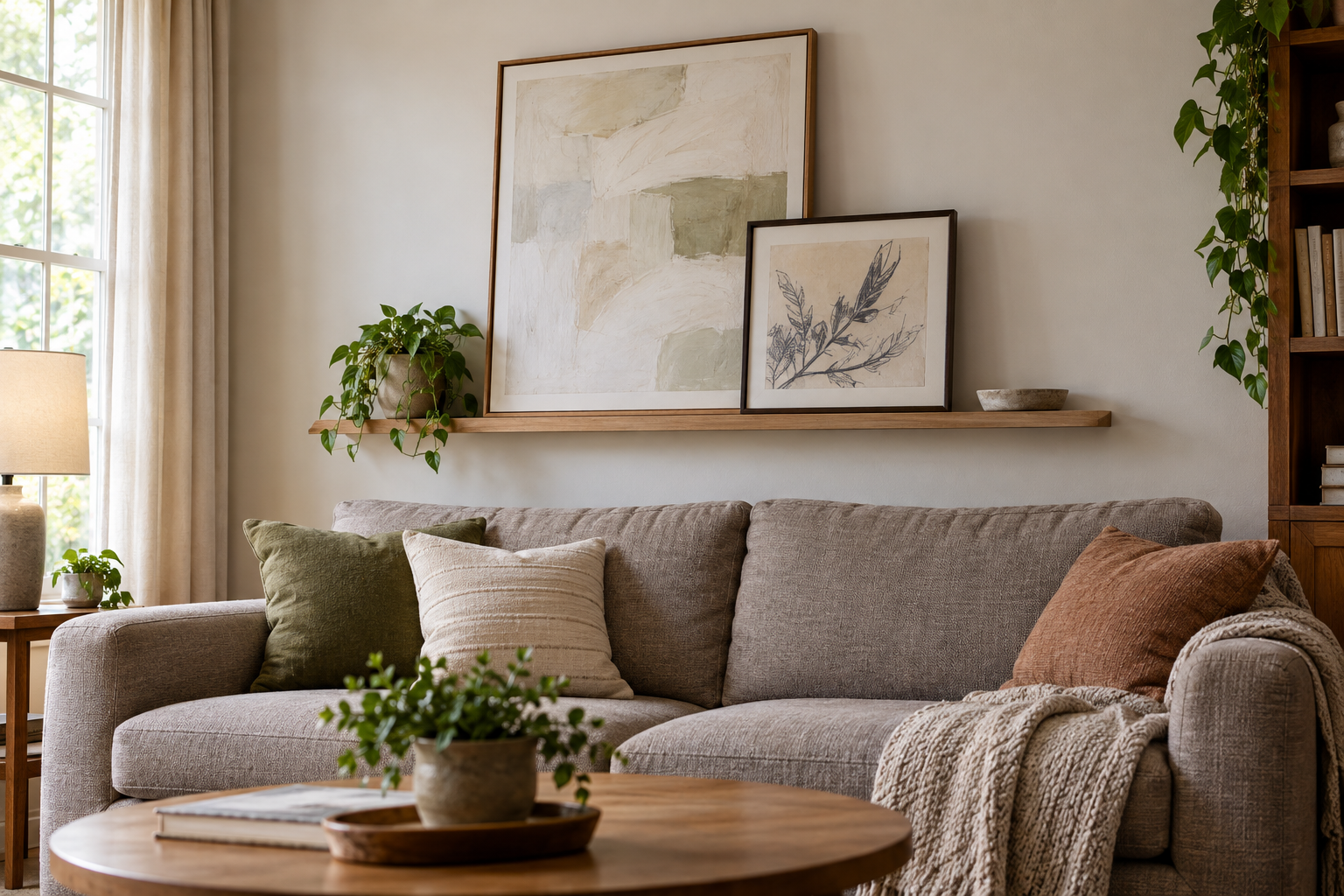
A ledge for artwork you like to change
A picture ledge is a good fit if you swap prints or move a favorite image between rooms. Try a taller rear frame with a smaller frame overlapping one lower corner. Keep both subjects readable: a pale abstract behind a compact charcoal drawing gives the layers different roles. After installation, compatible frames can be rearranged without additional hanging holes.
Sit on your sofa and lean back normally to assess the proposed ledge edge and leaning frames against your seated position; an illustration cannot establish clearance. Check frame depth, width and overlap against the ledge instructions, and use fixings appropriate to the wall and loaded weight. If the display would intrude on your seating, choose a hung pair.
Pale ash or slim black: borrow a room detail
Try pale ash frames with flax-and-clay imagery for a restrained, warm palette. Repeat the clay in a cushion or the pale wood in a side table. For a darker alternative to the illustrated pale wood, echo a dark wood table or cabinet with the listed dark-oak-finish frame or dark brown ledge: one supports a single image or matching pair, the other rotating layers.
Try slim black frames with charcoal linework for a more graphic outline, echoing a black lamp stem or table leg. Leave generous pale space inside the artwork; shared charcoal marks can connect different images. The listed black frame is black-finished engineered wood, so choose it for this color connection rather than a pale-wood material match. Its verified details do not establish a slim profile.
The two-thirds guideline in numbers
Two thirds of the sofa’s width is a starting point for the total width of the art, gaps included:
- 72-inch sofa: about 48 inches of art.
- 84-inch sofa: about 56 inches.
- 96-inch sofa: about 64 inches.
A little narrower is fine; much narrower is what makes art look stranded. If your favorite print is small, a wide mat and a larger frame, or a pair, gets you closer to the guideline without replacing the art.
Try it before you drill
- Cut paper or cardboard to the size of each frame.
- Tape the shapes to the wall with low-tack painter’s tape, starting about 6 to 10 inches above the sofa back.
- For a pair or group, keep the gaps even, usually about 2 to 3 inches.
- Look from the doorway and from the sofa, then adjust before any holes go in.
- Mark the hanging points on the paper, so the nail goes exactly where the template says.
Renting or not ready to drill
A picture ledge needs fewer holes than a gallery, and lets you change the art later without new ones. Removable picture-hanging strips can work for light frames on smooth walls, within the exact product’s weight rating; do not rely on them for heavy or glass frames above a seat. Leaning a large piece on a console behind the sofa is another option that needs no fixings at all.
Tie the art to the room
Repeat one color from the art in a cushion or throw on the sofa, and match the frame finish to something nearby, such as a lamp base or table legs. Our guide to colors around a gray sofa shows how to decide whether the art or the cushions should carry the strongest pattern.
Pieces to consider
Large black poster frame
For 24 × 36-inch artwork with charcoal linework; compare the complete arrangement with your sofa before choosing one frame or a pair.
Product details
Americanflat 24 × 36 poster frame, black
- Listed size: 24 × 36 in
- Listed finish: Black, engineered wood
Large dark-oak poster frame
For one 24 × 36-inch image, try the dark-oak finish to echo darker wood furniture rather than the illustrated pale wood.
Product details
Americanflat 24 × 36 poster frame, dark oak
- Listed size: 24 × 36 in
- Listed finish: Dark Oak
Picture ledge shelves, 36 in
For rotating, overlapping artwork, try dark brown instead of the illustrated pale wood; check frame-depth compatibility and follow the ledge instructions.
Product details
Forbena 36 in picture ledge shelves, dark brown
- Listed size: 36 × 4.5 in
- Listed color: Dark Brown
Affiliate links. As an Amazon Associate I earn from qualifying purchases. Not hands-on tested; the illustrations do not show these exact products.