Wall-mounted and table lamps solve small-bedroom lighting in different ways — one frees the nightstand, the other generally needs no wall work at all. Here's how to weigh space, your lease, and light quality, or mix both sides of the bed.
 Concept image
Wall lamps free up nightstand surface, but mounting means checking your lease and sometimes hiring an electrician. Table lamps generally need no wall work and are easy to change, but require a stable surface with room for the full base and shade. Many small bedrooms work well with one of each.
The Real Trade-Off in a Small Bedroom
Picture a bedroom just large enough for a queen bed and a narrow strip of floor on either side. A single warm-toned bulb glows beside the pillow, softening the white walls to the color of toast. On the nightstand, there's room for exactly one thing: a paperback, a phone, or a water glass, but not all three. The lamp itself claims the rest of the surface, and every night you nudge it aside to reach for your book.
In a room this size, lighting is one of the first things the eye lands on, not a background detail. Choosing between a wall-mounted lamp and a table lamp shapes how much surface space you keep, how settled the room feels at a glance, and how easily you can change your mind later. The right answer depends on your walls, your lease, and how you actually use the space beside your bed.
Space and Visual Clutter
A wall lamp mounts above or beside the bed, so the nightstand underneath stays open. That freed-up surface can hold a book, a small plant, or nothing at all, and an open surface in a small room often reads as more spacious than a full one, even when the square footage hasn't changed.
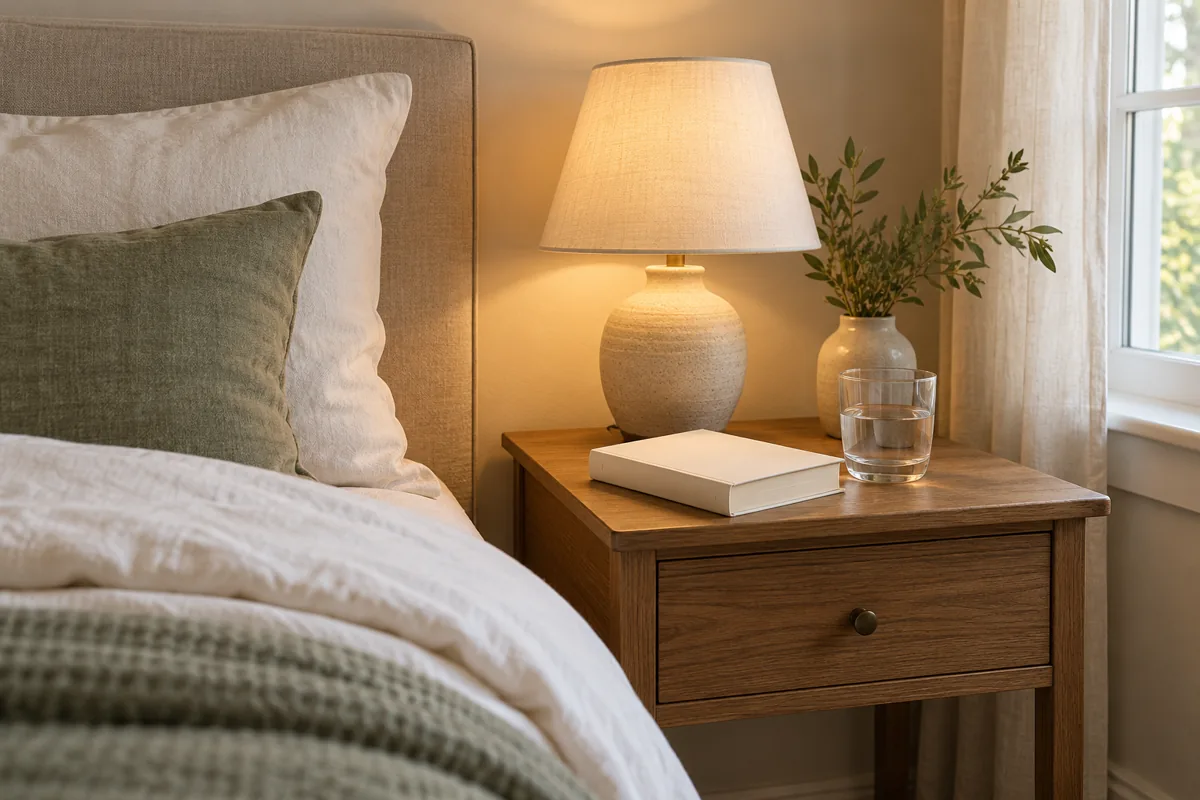
A table lamp asks more of your furniture. It needs a stable surface for its base, plus enough clearance around it that the shade doesn't overhang the edge or crowd whatever else lives on the nightstand. On a narrow surface, the lamp can end up as the main feature, leaving little room for anything else.
- Set the lamp on the nightstand before you commit and check the full footprint — base and shade together — against the surface, not just the base alone, so you can see what room is left for the item you reach for most at night.
- Give the lamp a gentle nudge once it's in place; if the base rocks or the shade sways, look for a heavier or wider base rather than a taller shade.
Renter-Friendliness and Installation
If you're renting, check your lease before drilling into any wall, even for a small anchor. Many leases restrict or prohibit permanent changes, and a hardwired wall lamp — one wired directly into the wall's electrical system — requires a licensed electrician and isn't something to install or remove without professional help.
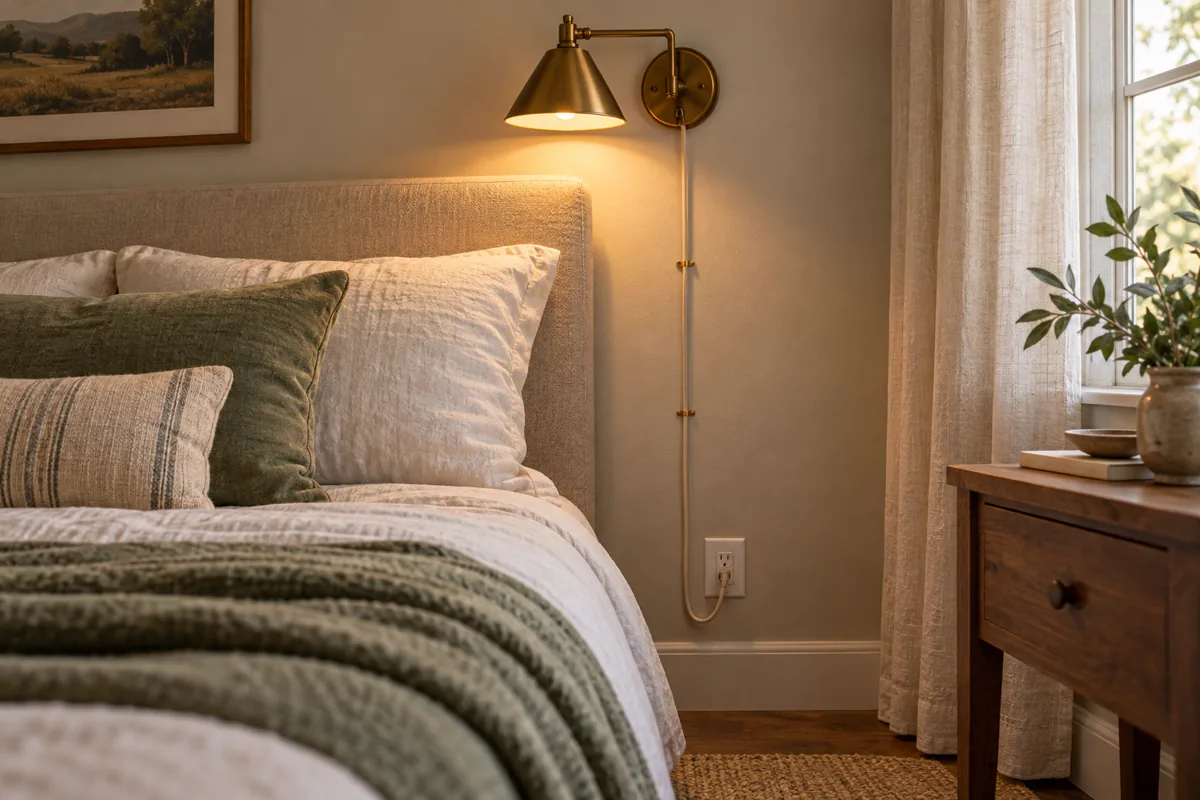
A plug-in wall lamp is a common middle ground: it mounts to the wall with anchors suited to your wall type, following the manufacturer's instructions, but draws power from a nearby outlet with a visible cord rather than being wired in. It still puts a hole in the wall, so the lease question applies here too.
Table lamps sit on a surface and generally require no wall work, since there's nothing to mount. They can be unplugged, packed up, and brought along to the next apartment without leaving a mark behind.
- Ask your landlord for written approval before drilling, even for a small picture-hanging anchor, so you have a record if the question comes up later.
- If you choose a plug-in wall lamp, check that the cord reaches the nearest outlet without crossing a walkway.
Light Quality and Function for Reading or Winding Down
Light quality depends less on whether a lamp mounts to the wall or sits on a table, and more on the shade shape, where the fixture sits, and whether it adjusts. A wall lamp with a swing arm and a table lamp with a tiltable shade can both direct light onto a page; a wall lamp with a fixed, upward-facing shade and a table lamp with a wide drum shade will both spread light more broadly around the room instead of pinpointing it.
For reading in bed, look for a shade that narrows toward the bottom or a fixture that lets you angle the light source itself, whichever type you choose. For winding down, a more open or diffusing shade set a little distance from the pillow spreads a softer glow across the room instead.
The shade and the light's direction matter more for comfortable reading than the bulb's wattage. A bright bulb under a wide, open shade can still feel dim on the page if the light scatters before it reaches you; a lower-wattage bulb under a focused shade can feel brighter right where you need it.
- Sit up in bed the way you would to read, and check whether the bulb or a bright edge of the shade sits in your direct line of sight; if it does, adjust the angle or height before settling on a spot.
- Look for a fixture that accepts a dimmable bulb if you want one light for reading and a softer setting for winding down.
Styling Flexibility and Room to Evolve
A table lamp is a low-commitment choice in the room. Swap it for a new base and shade when you redecorate, move it to a shelf if you rearrange the furniture, or take it along when you move, all without a tool.
A wall lamp is more of a fixed decision. Once it's mounted and the wall is patched around it, moving it to a new spot means new holes, new patching, and possibly a new coat of paint. That's a reasonable trade for the surface space it gives back, but it's worth choosing a finish and style you expect to like beyond this season.
- If you like to restyle often, consider keeping the wall lamp finish neutral and making seasonal changes through the bedding and the shade of a paired table lamp instead.
When Wall Lamps Win
Wall lamps make sense when floor and surface space are genuinely tight: a nightstand too small to hold a lamp comfortably, or no nightstand at all. Mounted at the right height, a wall lamp can take over as the only bedside light, with a small floating shelf nearby for the essentials.
They're also a good match for shared or small beds, where two people read or sleep on either side. A wall lamp positioned individually over each side lets one person read without a bulky lamp base taking up space on a shared or narrow surface between the two.
In households with young children or pets, a wall lamp keeps the fixture itself off the nightstand. Any mounted fixture should still be installed, and its cord routed, exactly as the manufacturer directs — a reachable cord or a loosely anchored fixture can be a hazard with either type of lamp.
- Mount lamps at matching heights on each side of the bed and mark both spots with painter's tape before drilling, so the pair reads as intentional rather than approximate.
When Table Lamps Win
Table lamps are the clearer choice for renters who can't or don't want to put anything into the walls. Because they sit on a surface instead of mounting to one, they generally involve no anchors and no patching when you move out.
They also win if you like to change your room's look often. A new lamp is one of the fastest ways to shift a bedroom corner's mood — swapping a sleek metal base for a ceramic one, or a drum shade for a pleated one, changes the feel of the space without touching anything else in the room.
And if your nightstand has surface to spare, a table lamp keeps your bedside light entirely self-contained: unplug it, move the whole nightstand, and the light goes with it.
- Add a small felt pad under the lamp base to protect the nightstand's finish and make it easier to slide the lamp aside when you need the surface.
Verdict by Situation
Reach for a wall lamp when the open floor beside the bed is too narrow for a nightstand with any surface to spare, or when one side of the bed sits tucked into a corner with no room for a table at all. In a gap like that, a mounted lamp lights the pillow without asking for any nightstand, table, or floor space in return — check your lease before you drill, and call a licensed electrician for anything hardwired.
Lean toward a table lamp if you expect to move again within the year, or if you share the lease with roommates who'd also need to weigh in on wall anchors. A table lamp sidesteps that conversation: it plugs into an outlet, sits on whatever surface you already have, and packs into a box unplugged when you go.
When you pair a wall lamp with a table lamp across an unmatched bed, line up the light itself rather than the furniture underneath it — set the bottom edge of the wall shade level with the top of the table lamp's shade on the other side. That shared line is what reads as a considered pair once both lamps are lit, even though the fixtures underneath them look nothing alike.
- Match the metal finish across a mixed pair — both brass, both matte black, or both brushed nickel — so the two fixtures read as a set despite their different shapes.
What to look for
The pieces that make this look work, and what to check before you choose.
- Swing-arm wall sconce — Choose a finish that matches your existing hardware and an arm long enough to swing over the pillow if you want directed reading light. Look for: Plug-in or hardwire compatible, matched to what your lease and wiring allow; An adjustable arm or swiveling shade if you want directed reading light; A backplate compact enough for a narrow section of wall; A finish that complements door handles, faucets, or other hardware already in the room.
- Bedside table lamp — Check the full base-and-shade footprint against your nightstand, and confirm the shade angle stays comfortable when you're sitting up to read. Look for: A base and shade footprint that leaves room on the nightstand for what you use most, not just the base alone; A shade shape and angle that avoid glare from a seated reading position; A stable, weighted base that resists tipping if bumped; A switch you can reach easily from bed, whether in-line or on the base.
- Compact nightstand or floating shelf — A narrow nightstand or a single floating shelf can hold the essentials without crowding a tight walkway. Look for: A footprint that fits your available wall or floor space without narrowing the walkway beside the bed; Enough surface area for a lamp's full footprint plus the items you use most, if pairing with a table lamp; Optional entirely if you're pairing with a wall lamp instead.
- Cord clips or channel — Low-profile clips keep a lamp's cord along the wall or table leg instead of underfoot. Look for: Keeps cords off the floor and away from the path to the door or bathroom; A low profile that doesn't compete visually with the lamp itself; Adhesive or screw-in options depending on what your wall or furniture allows.
- Warm-toned bulb — A warm bulb keeps a small bedroom feeling relaxed rather than clinical once the sun goes down. Look for: A warm color temperature suited to winding down; Wattage within the fixture manufacturer's stated maximum; A dimmable option if your fixture and switch support it.
Common questions
Do I need an electrician to install a wall lamp?
Only if it's hardwired directly into the wall's electrical system — that installation should go to a licensed electrician. A plug-in wall lamp draws power from a nearby outlet instead, but mounting it still means putting anchors into the wall, so check your lease first either way.
Which option is better for renters?
Table lamps generally require no wall work, since they sit on a surface rather than mount to one. A plug-in wall lamp is also an option for renters, but only after checking the lease and getting approval for anchors in the wall.
Can I mix wall lamps and table lamps in the same bedroom?
Yes. Pairing one of each works well when the two sides of the bed aren't matched, such as one side against a wall with no nightstand and one with a full-size table. Lining up the bottom of the wall shade with the top of the table lamp's shade, and keeping the metal finishes matched, helps the pairing read as intentional rather than mismatched.
What if my bedroom doesn't have room for a nightstand?
A wall lamp mounted at bedside height can take over the nightstand's lighting job, and a small floating shelf nearby can hold the essentials without needing a full piece of furniture.
Is a wall lamp safer than a table lamp with young kids or pets in the room?
A wall lamp keeps the fixture off the nightstand surface, but any mounted fixture and its cord should be installed exactly as the manufacturer directs. A reachable cord or a loosely anchored fixture can still be a hazard with either type of lamp.