Seven distinct, rental-friendly ways to make a small bedroom feel bigger and calmer, from low furniture and tonal color to smarter storage and light.
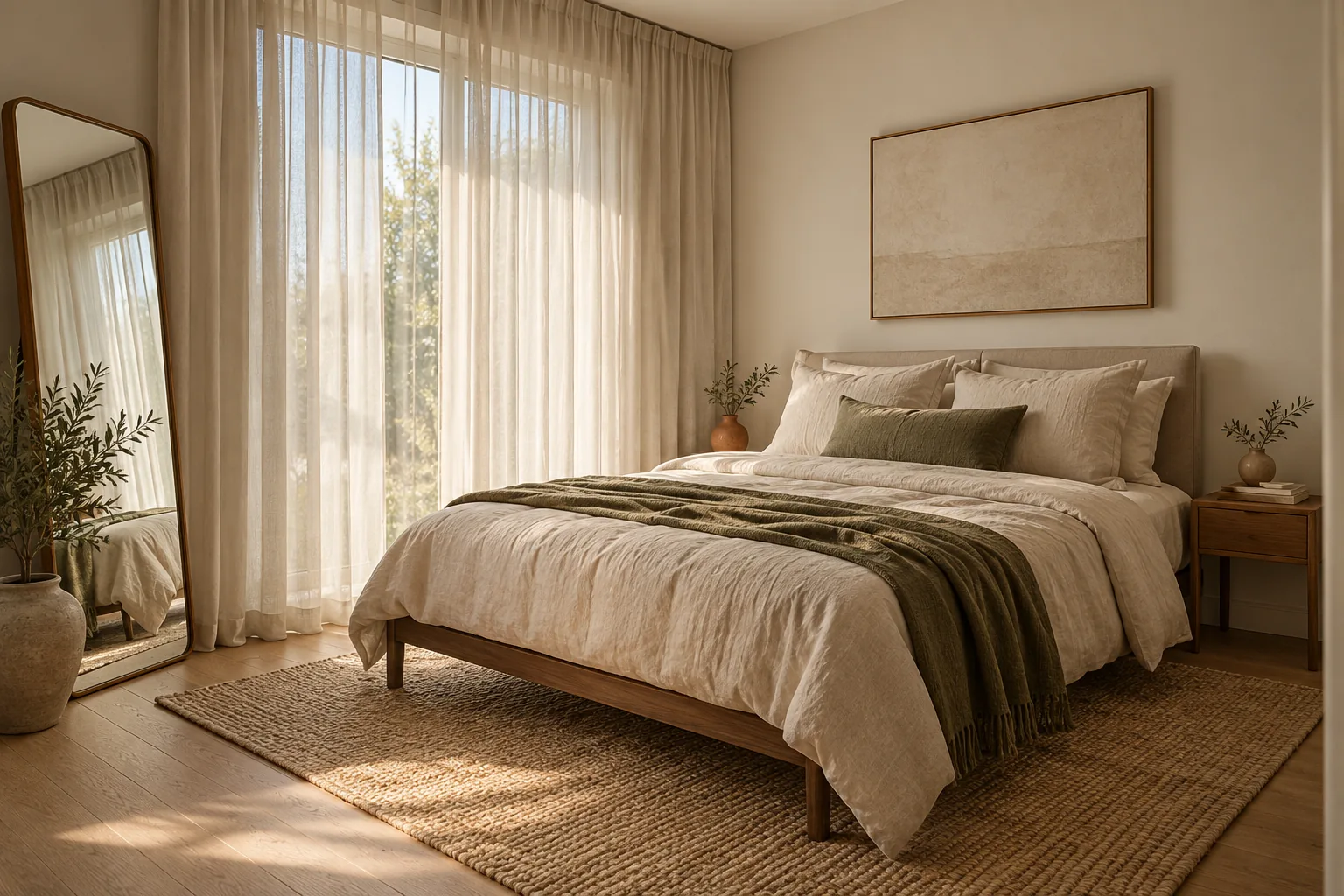 Concept image
Scale down furniture, unify the color palette, pull curtains and art upward, multiply light with mirrors, choose storage that fits your bed's actual clearance, edit visible surfaces, and layer in airy textiles. Many of these ideas need no drilling, and anything that mounts or attaches to a wall calls for checking your lease first.
The Low-Profile Retreat
Picture a bed that sits close to the floor, its frame slim enough that you can see clear across to the far wall underneath it. Nothing blocks the light moving through the room, and the space between the bed and the door feels open rather than pinched. That's the effect of choosing furniture with visible legs instead of solid, boxy bases — light and sightlines pass through, so the eye reads the floor as one continuous plane instead of a room broken into blocks.
In a rental, look for a platform bed frame with slender legs rather than a solid plinth base, and pair it with a nightstand or dresser raised the same way. Place your largest furniture piece along whichever wall keeps the door swing and main walkway clearest — often the longest wall, though every room's windows and doors fall differently — and leave a walkway of a couple of feet between the bed and any dresser or door swing so you can move through without turning sideways.
A common misstep is filling every wall with a large, solid piece — a bulky headboard on one side and a floor-to-ceiling dresser on the other. Even if each item is useful on its own, stacking solid mass on multiple walls closes the room in. Choose one larger piece and keep the rest low and light.
- Choose bed frames with exposed legs, not solid platform bases
- Place your largest furniture piece wherever it keeps walkways clearest
- Leave a walkway of a couple of feet between the bed and dresser
The Soft Monochrome Room
A small bedroom dressed in one soft color family — walls, bedding, and curtains all landing within a few shades of each other — tends to feel larger than one broken up by contrasting colors. Contrast lines create visual stops: the eye pauses at every color change, and each pause translates into a sense of a smaller, busier room. A tonal palette removes those stops, so the walls seem to recede instead of closing in.
This look doesn't require repainting if your lease doesn't allow it. Build the tonal effect through textiles instead: bedding, a throw, curtains, and a rug in shades close to your existing wall color, whether that's a warm white, soft greige, or muted clay. If you can paint, a single soft, light tone across all the walls (check your lease for any paint requirements first) reinforces the effect further.
A common mistake is choosing one accent color and using it everywhere — a bold headboard, matching curtains, and a rug in the same bright hue. That much saturated color in a small footprint can feel heavier than a few well-chosen neutral layers, even though the intention was to make a statement.
- Choose bedding and curtains within a few shades of your wall color
- Favor soft, muted tones over saturated color blocks
- Check your lease before repainting
The Vertical Lift
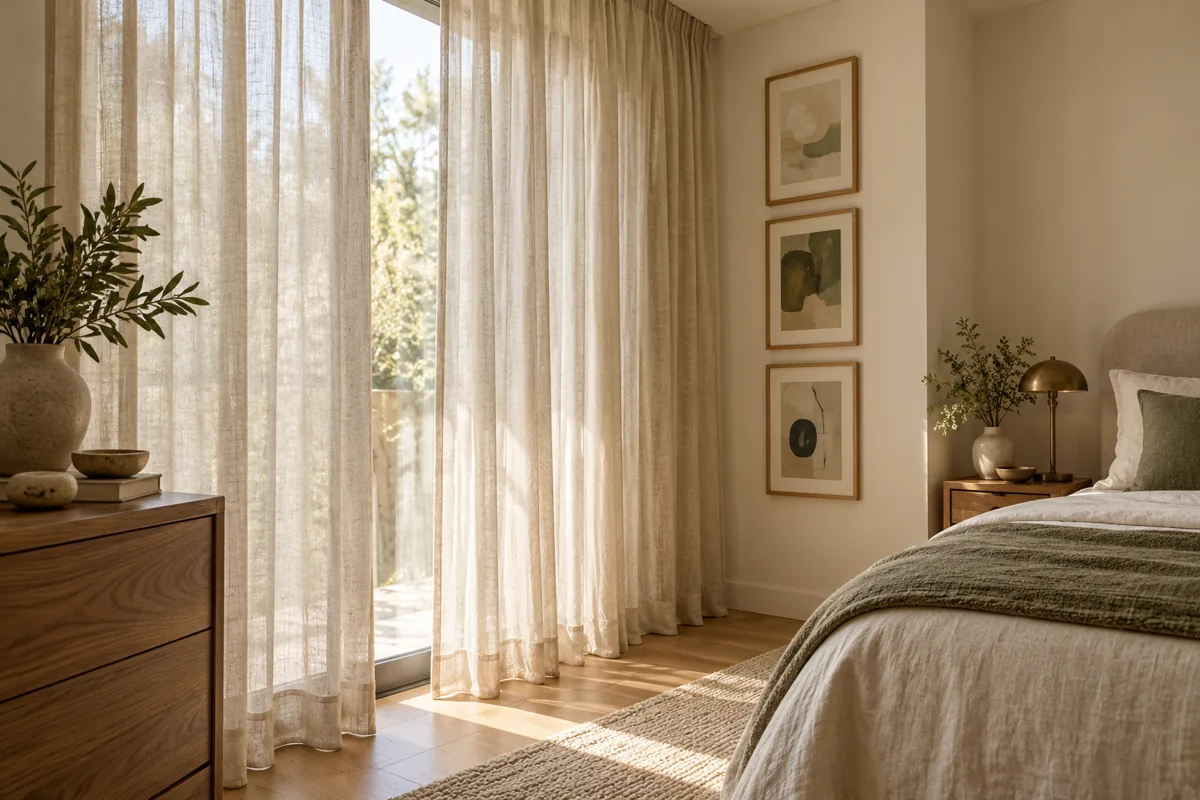
Hanging curtains near the ceiling line, well above the window frame, is one of the simplest ways to stretch a room's perceived height. The eye follows the fabric upward past where the window actually ends, and the ceiling reads as taller than it is. The same principle applies to art: a vertical grouping hung slightly above eye level pulls attention up the wall instead of across it.
Use a tension rod or a rental-safe curtain rod with removable mounting hardware rated for the rod's weight, and check your lease before installing anything on the wall. Choose a lightweight, sheer or semi-sheer fabric that reaches close to the floor — the continuous vertical line is what creates the lift, not the fabric's weight.
Mounting curtains directly on the window frame, with a short rod and fabric that stops well above the sill, is a common way this look falls flat. It shortens the window visually and draws a hard horizontal line right where you don't want one.
- Mount curtain rods close to the ceiling, not the window frame
- Choose curtains that graze the floor
- Group art vertically to draw the eye upward
- Check your lease before mounting any hardware
The Light-Multiplying Corner
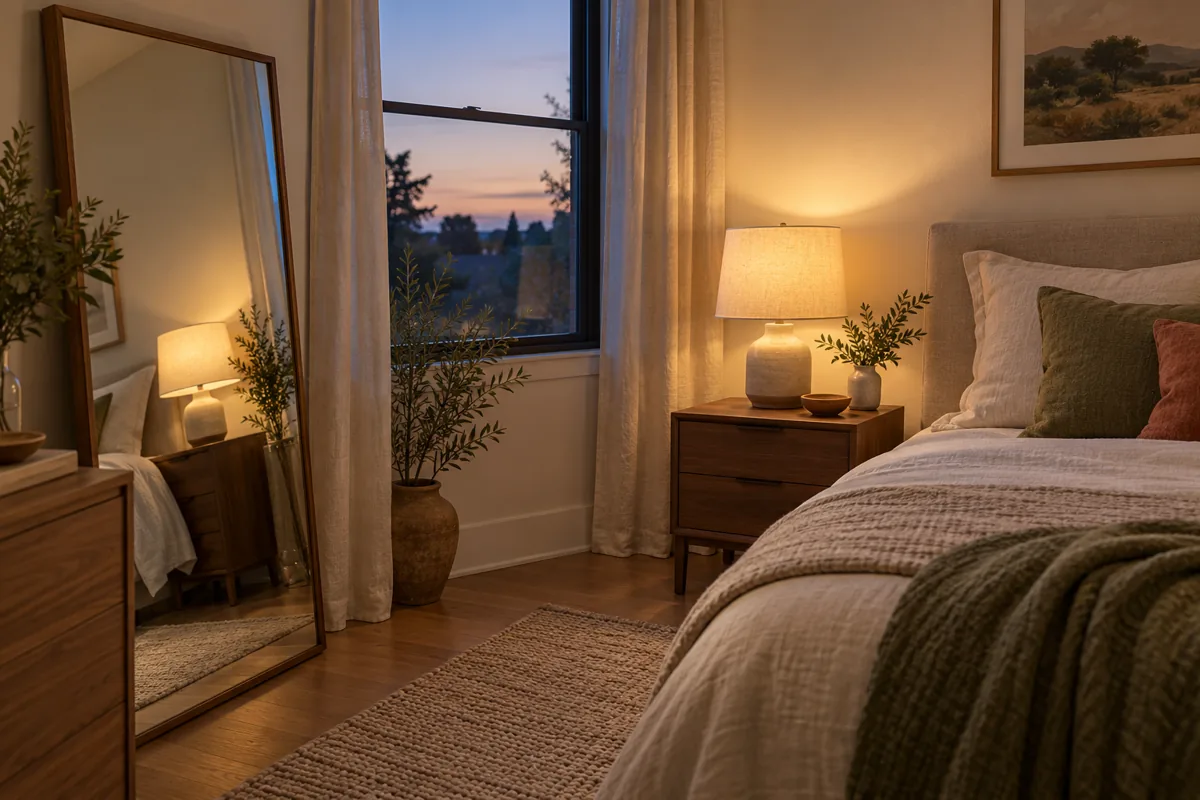
A mirror placed to reflect a window or a lamp does two things at once: it bounces available light back into the room, and it gives the eye a second, illusory version of the space to read. Paired with layered lighting — an overhead fixture plus a lamp or two at different heights — a small bedroom can feel more open in the evening than it would under a single bright overhead light, which can leave the room lit in one flat, even wash rather than layers of light and shadow that suggest depth.
A freestanding leaning mirror is often a good option for a rental. Secure it exactly as the manufacturer instructs — some models include a safety strap or bracket that anchors to the wall or floor to keep the mirror from tipping — and check your lease before attaching anything to a wall. Position it well clear of the bed and any walking path. Add a table or floor lamp with warm, soft light near a reading chair or nightstand, routing the cord along a wall edge so it isn't a trip hazard.
Leaning a mirror against a wall without securing it as directed is worth avoiding, since an unsecured mirror can tip. Keep any mirror's footprint out of the direct path between the bed and the door.
- Position a mirror to reflect a window or lamp
- Secure any mirror exactly as the manufacturer instructs, including any wall or floor attachment
- Check your lease before attaching anything to a wall
- Add a lamp for layered light instead of relying on one overhead fixture
- Keep mirrors clear of the bed and walking path
The Hidden Storage Edit
Storage that lives below the bed frame or behind a door doesn't compete with the room's floor space the way a freestanding dresser does. But a low-profile frame — the kind that helps a small room feel open, as in The Low-Profile Retreat above — sometimes leaves only a few inches of clearance underneath, or none at all. Measure that gap before buying anything meant to slide under the bed.
If there's enough clearance, a low-profile, lidded storage bin keeps out-of-season clothing or linens out of sight while keeping the look tidy. If there isn't, look for a bed frame with built-in drawers in its base, or add a storage bench or ottoman at the foot of the bed for folded linens or extra bedding. Over-door hooks and slim, freestanding shelving units add hanging or display space without any wall damage, which makes them a straightforward option in a rental. If you do want wall-mounted shelving, check your lease first, and follow the manufacturer's instructions and weight rating for the mounting hardware.
Buying storage taller or deeper than the room can comfortably absorb — a large freestanding wardrobe wedged into a room already tight on space — often works against the goal. Measure the walkway you'll have left before committing to a new piece.
- Measure the clearance under your bed frame before buying storage bins
- Choose a bed frame with built-in drawers or a storage bench if clearance is limited
- Add over-door hooks for hanging storage with no wall damage
- Check your lease before mounting any wall shelving
- Measure remaining walkway space before adding a new storage piece
The Curated Surface
A dresser top crowded with a dozen small objects reads as visual noise, and visual noise makes a small room feel smaller because there's more for the eye to process in a limited area. Limiting a nightstand or dresser to a few intentional pieces — a lamp, a small tray, one or two objects with meaning — gives the eye places to rest.
This is one of the simplest ideas to try, since it starts with editing what you already own. Spend an evening reviewing what's currently out on your surfaces, group what remains onto a small tray so the space still feels styled rather than bare, and store the rest in a drawer or bin.
Decorating a small surface as though it were a mantel — filling every inch with framed photos, candles, and trinkets — is an easy trap. Each object is fine on its own, but together they crowd a surface that has less room to spare than one in a larger space.
- Limit visible objects on nightstands to a few intentional pieces
- Group small items on a tray to keep surfaces styled, not cluttered
- Edit what you have before adding anything new
The Airy Textile Layer
Textiles carry visual weight. A dark, heavy rug or a thick, patterned duvet can make a small floor area feel more enclosed, while lighter, softer tones in the same spots tend to open the room up. This is a matter of preference and the mood you're after, but if the goal is spaciousness, softer textiles help.
Choose a rug sized to extend at least partway beneath the mattress and reach a couple of feet past the foot of the bed, rather than a small rug that floats in the middle of the floor with bare floor showing on every side — a too-small rug tends to make the room look choppier, not larger. Layer in a lightweight throw and sheer or semi-sheer curtains to keep the room feeling airy rather than heavy.
A small rug centered under just the bed, with bare floor showing all around it, is a common textile mistake in a small bedroom. Sizing up, even slightly, makes a noticeable difference.
- Size your rug to extend under the bed and past its foot
- Choose lighter, softer tones for rugs and bedding if openness is the goal
- Avoid a small rug that floats without reaching any furniture
What to look for
The pieces that make this look work, and what to check before you choose.
- Low-profile platform bed frame — Choose a frame with slim, visible legs rather than a solid base so light and sightlines pass underneath. Look for: Exposed or slim legs instead of a solid plinth base; A frame height that keeps the mattress low relative to the room; Overall dimensions that leave a walkway on at least one side.
- Floor-to-ceiling sheer curtains — Mount them close to the ceiling line, well above the window frame, to stretch the room's perceived height. Look for: A rod long and high enough to clear the window frame; Lightweight, sheer or semi-sheer fabric; A length that grazes the floor; Rental-safe mounting hardware rated for the rod's weight.
- Leaning or wall mirror — Position it to reflect a window or lamp, and secure it exactly as the manufacturer instructs. Look for: A size that reflects a window or major light source; A slim frame that doesn't add visual bulk; Manufacturer-specified securing hardware, such as a strap or bracket, if the model requires one.
- Secondary layered lighting — Add warm, soft light at a lower height instead of relying on a single overhead fixture. Look for: Warm-toned light output rather than a bright white or cool tone; A compact footprint for a nightstand or narrow corner; A cord length that allows routing along a wall edge, away from walkways.
- Under-bed storage bins or a drawer-base bed frame — Measure your bed frame's actual clearance first; choose bins if there's room, or a bed with built-in drawers if there isn't. Look for: A bin height that's been measured against your bed frame's clearance before buying; A lid or cover to keep contents out of view; For drawer-base frames, drawers that glide smoothly on the frame's own hardware.
- Large-format area rug — Size it to extend partway under the bed and a couple of feet past its foot, rather than floating alone. Look for: Dimensions large enough to reach under at least part of the bed; A light or soft tone if openness is the goal; A low pile for easy movement and cleaning.
- Floating or freestanding vertical shelf — A narrow, tall shelf adds display space without crowding the floor; check your lease before mounting anything. Look for: Rental-safe mounting hardware or a freestanding design; A narrow depth to keep the walkway clear; A weight rating appropriate for what you plan to display.
Common questions
What's the fastest way to make a small bedroom feel bigger without buying anything?
Start with the two changes that use what you already have: edit what's on your surfaces down to a few pieces, and check whether your bed or dresser could shift to open up a walkway. Both ideas are covered in The Curated Surface and The Low-Profile Retreat sections above.
Is it safe to hang curtains or shelving in a rental?
Check your lease first, since rules on wall damage and hanging items vary. Tension rods and rental-safe curtain hardware rated for the rod's weight are common options for curtains, and any wall-mounted shelving should follow the manufacturer's instructions and weight rating.
Will a dark rug or bedding ruin the effect?
Not necessarily — this is a matter of preference. Lighter, softer tones tend to feel more open in a small room, but a darker textile layered thoughtfully alongside lighter walls and curtains can still work if that's the mood you want.
Where should I put a mirror in a small bedroom?
Position it to reflect a window or a lamp so it bounces light into the room, and keep it clear of the bed and any walking path. Secure it exactly as the manufacturer instructs, which may include a strap or bracket anchored to the wall or floor, and check your lease before attaching anything to a wall.
Do I need to repaint to get a monochrome look?
No — you can build a tonal palette through bedding, curtains, and a rug in shades close to your existing wall color. If your lease allows repainting, a single soft, light wall color reinforces the effect further.